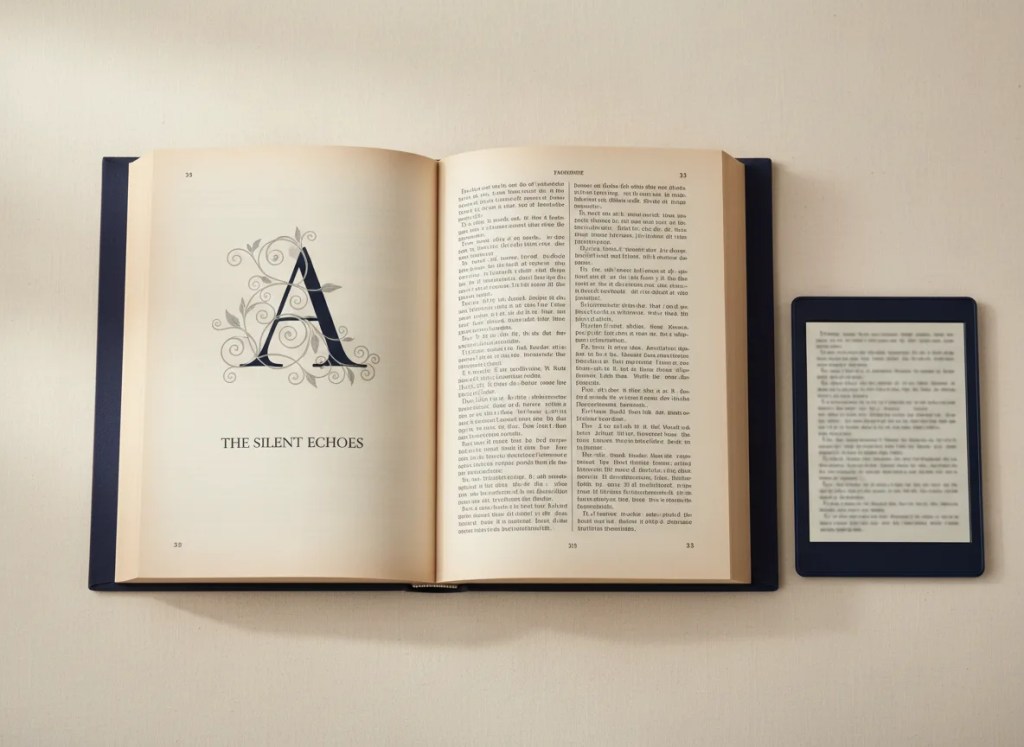
Many first-time authors assume one file will work for every edition of their book. In reality, ebooks and print books behave very differently, and each needs its own formatting to look professional.
How ebooks work
Ebooks use reflowable text. Readers can change the font, text size and screen orientation, so there are no fixed pages. That means:
- Page numbers and headers do not apply in the usual way
- A clickable table of contents is essential for navigation
- Complex layouts, tables and decorative fonts may not display as intended on every device
- Images need to be optimised so the file stays a reasonable size
How print books work
A paperback is a fixed layout: every page looks exactly the same for every reader. Good print formatting pays attention to details readers notice even if they cannot name them:
- Trim size: the physical dimensions of the book, usually chosen to suit the genre
- Margins and gutter: extra inner margin so text does not disappear into the spine
- Running headers and page numbers: placed consistently and left off chapter-opening pages
- Widows and orphans: avoiding single lines stranded at the top or bottom of a page
- Chapter openings: consistent styling that makes the book feel polished
Why your cover depends on your interior
For print editions, the width of the spine depends on the final page count and paper type. That is why the print cover is usually finished after the interior is formatted. Change the trim size or font, and the page count changes too.
Before you upload
Each platform, such as Amazon KDP and IngramSpark, has its own file requirements. Always check their current guidelines and preview your files with their tools before publishing. Ordering a printed proof copy is the best way to catch problems before readers do.
Let us handle the technical side
Velora Publishing formats both your ebook and print editions and prepares files to each platform’s specifications, so you can launch with confidence. Get a free quote.


Leave a comment