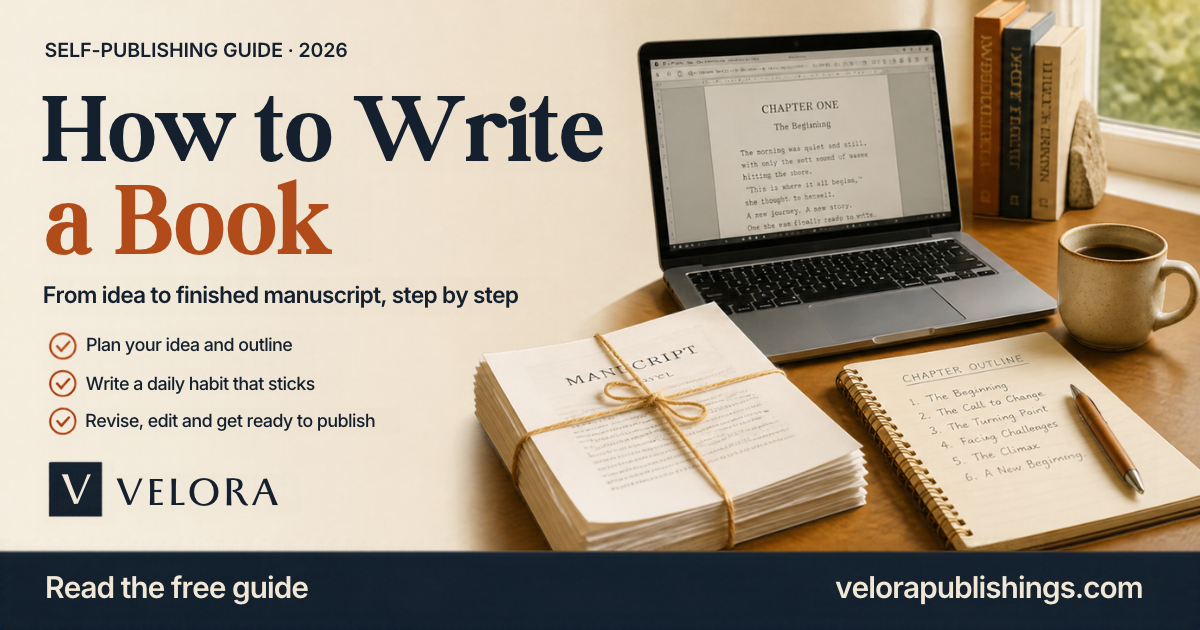
You’ve had the idea for years. Maybe it’s the business lessons you’ve learned, a novel that keeps playing in your head, or a story your family has heard a hundred times. But every time you sit down to start, the blank page wins.
Writing a book isn’t about talent or free time. It’s about a clear plan and a habit you can keep. This guide shows you how to write a book step by step, from first idea to a finished manuscript that’s ready to edit and publish.
Quick answer: how to write a book in 9 steps
- Define your idea in one sentence.
- Know your reader: who is this book for?
- Set a target word count for your genre.
- Outline your book chapter by chapter.
- Build a writing habit with a daily or weekly goal.
- Write a fast, imperfect first draft.
- Revise for structure, then for sentences.
- Get feedback from beta readers.
- Hire a professional editor, then publish.
Step 1: Define your idea in one sentence
Before you write chapter one, write one sentence that explains what your book is about and why it matters. For example: “A practical guide that shows small business owners how to win their first ten clients,” or “A retired nurse uncovers a secret that could tear her small town apart.” If you can’t say it in a sentence, the book will be hard to write, and harder to sell.
Step 2: Know your reader
Picture one person who will read your book. How old are they? What do they already know? What problem do they want solved, or what experience do they want to feel? Writing for one clear reader keeps your tone consistent and helps you decide what to include and what to leave out.
Step 3: Set a target word count
A target turns a vague dream into a measurable project. Typical ranges:
| Type of book | Typical word count |
|---|---|
| Adult novel (general) | 70,000–100,000 |
| Romance | 70,000–90,000 |
| Mystery | 65,000–90,000 |
| Thriller / suspense | 70,000–100,000 |
| Memoir | 60,000–90,000 |
| Self-help | 40,000–70,000 |
| Middle-grade children’s | 20,000–55,000 |
These are guidelines, not rules. A focused business or how-to book can be shorter if it delivers what the reader needs. Your word count also affects your page count and print cost; try our free word and page count calculator.
Step 4: Outline your book
An outline is your map. It doesn’t need to be detailed, but it should show where you’re going.
- For non-fiction: list the main problem, then 8–15 chapters that each answer one question or teach one step. Note the stories, examples and data you’ll use in each.
- For fiction: sketch the beginning (who your character is and what they want), the middle (what gets in their way) and the end (how they change). Add the key scenes in between.
- For memoir: choose your theme and the moments that illustrate it. See our guide on how to write a memoir.
Step 5: Build a writing habit
Books get written in small, regular sessions, not rare bursts of inspiration. Simple math shows how achievable it is:
| Words per day | 60,000-word draft | 80,000-word draft |
|---|---|---|
| 250 (about one page) | 8 months | about 11 months |
| 500 | 4 months | just over 5 months |
| 1,000 | 2 months | under 3 months |
- Pick a regular time, such as early morning, lunch break or after dinner, and protect it.
- Set a small, realistic goal. It’s better to write 300 words every day than 3,000 once a month.
- Track your progress on a calendar. Seeing the streak grow is motivating.
- Remove distractions: phone in another room, notifications off.
Step 6: Write a fast, imperfect first draft
The first draft’s only job is to exist. Don’t stop to fix sentences, check facts or rewrite chapter one again. Leave notes like [CHECK DATE] or [ADD EXAMPLE] and keep moving. Every professional author’s first draft is messy; the magic happens in revision.
Step 7: Revise in two passes
- Big-picture pass: does the structure work? Is anything missing, repeated or out of order? Does every chapter serve your one-sentence idea?
- Line-by-line pass: tighten sentences, cut filler words, fix clunky dialogue, and make sure the voice is consistent.
Tip: take a break of a few weeks between finishing your draft and revising it. Fresh eyes catch far more.
Step 8: Get feedback from beta readers
Beta readers are people from your target audience who read your revised manuscript and tell you honestly what worked and what didn’t. Ask specific questions: Where did you get bored? What confused you? What did you love? Three to five thoughtful readers are worth more than twenty polite ones.
Step 9: Hire an editor, then publish
Even the best writers need an editor. Depending on your manuscript, that might be a developmental edit, a copy edit, a proofread, or a combination. Learn the differences and typical 2026 costs in How to Find a Book Editor.
Once your book is edited, the publishing steps are: a professional book cover, interior formatting, an ISBN, and uploading to Amazon KDP and other stores. Our KDP publishing guide walks you through it.
7 common mistakes first-time authors make
- Waiting for inspiration instead of building a habit.
- Editing chapter one forever and never finishing the draft.
- Writing for everyone instead of one clear reader.
- Skipping the outline and getting lost in the middle.
- Comparing your first draft to someone else’s finished book.
- Asking only family for feedback. They love you too much to be honest.
- Publishing without professional editing. Readers notice, and reviews suffer.
Frequently asked questions
How long does it take to write a book?
It depends on your length and pace. At 500 words a day, a 60,000-word first draft takes about four months. Revising and editing usually add a few more months.
Do I need to be a good writer to write a book?
You need something worth saying and the persistence to finish. Clear, simple writing is more valuable than fancy prose, and editing will polish the rest.
Should I write in Word or special software?
Microsoft Word or Google Docs is perfectly fine for most authors. Use whatever you’re comfortable with; your editor and formatter can work from a standard Word file.
Am I too old to write my first book?
Not at all. Your experience is your advantage. Many successful authors publish their first book later in life, especially in non-fiction and memoir.
Finished your manuscript? Here’s what comes next
Writing the book is the biggest step. When you’re ready, Velora Publishing can take it from manuscript to published book with editing and proofreading, cover design, formatting and Amazon KDP publishing. Your book goes live under your own account, and you keep 100% of your rights and royalties.
Get a free review of your book within 48 hours: three specific improvements and an exact quote, with no obligation. Email finharper@velorapublishings.com.
Word count ranges: SelfPublishing.com, Word Counts by Genre (2026). Information checked October 2026.
Leave a Reply